The Transformation Ahead: How AI and Digital Credentials Will Reshape International Admissions (Part 2)

Dev Srivastava
This is Part 2 of a two-part series exploring the past century of international education and predictions for the next decades. Read Part 1 here for the historical context from 1925-2025.
In Part 1, we traced how international education in United States evolved from slow paper-and-mail-based workflows handling a few thousand students to a sophisticated digital ecosystem processing one million international students annually. We saw a consistent pattern: each generation faced seemingly insurmountable challenges – complexity, scale, fraud, compliance – and responded by building the infrastructure that subsequent generations would take as given.
Now, as we stand at the beginning of 2026, we're witnessing another inflection point. Just as with previous transitions, we're seeing two distinct challenges emerge: the problem of machine readability of the documents we use within digital ecosystems and the problem of authenticity. And just as before, innovation is emerging to address both – but this time along two parallel tracks that will define the next twenty years.
The Future We're Building (2025 and Beyond)
By 2020, we reached the milestone of one million international students. But as we move through the latter half of this decade, we're witnessing a new inflection point – one that echoes the profound shifts of previous eras. We're seeing two distinct challenges emerge: the problem of machine readability and the problem of authenticity.
These aren't new problems, of course. Universities have been wrestling with unstructured documents and verification challenges since the paper era. What's changed is the scale and sophistication of both the challenge and the solutions emerging to address them.
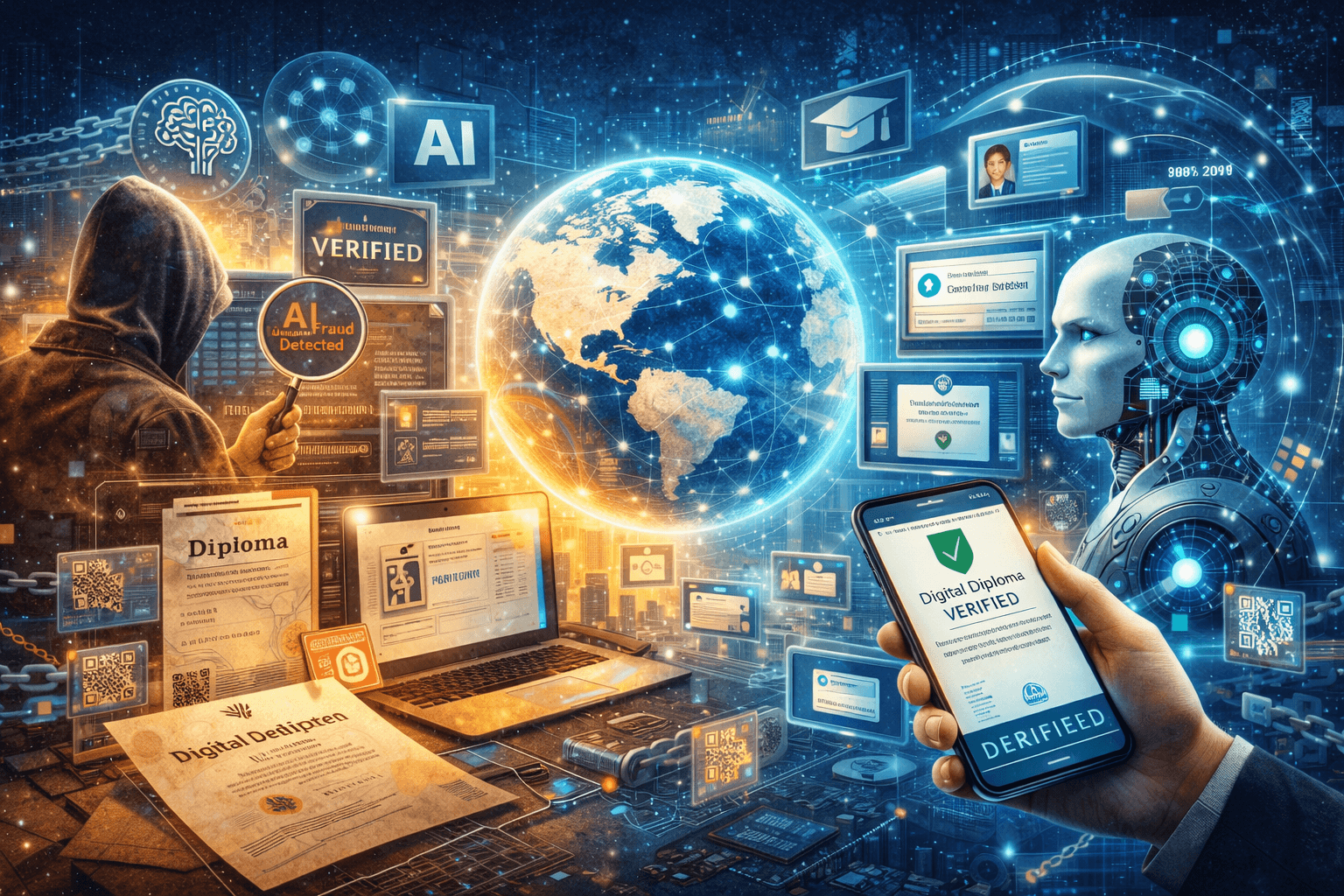
The Two-Track Future: AI as Bridge, Digital Credentials as Destination
As I think about the next two decades, I see two parallel tracks of innovation unfolding – one offering solutions we can implement today, and another building the infrastructure we'll rely on tomorrow.
The Near Term (2025-2028): AI as the Essential Bridge
New large language models have made document forgery rise at scale and become harder to detect. It's a problem that feels overwhelming – how do you verify thousands of transcripts when sophisticated fakes can be generated in minutes? In addition, diploma mills and bad actors within global higher education increasingly exploit fragmented accreditation systems and public information gaps to appear legitimate. Yet just as previous challenges spurred innovation, these ones are catalyzing a new generation of solutions.
From 2026 onwards, AI document parsing is expected to become industrial-grade. We're seeing deep-learning OCR that can handle multilingual documents, sophisticated layout analysis that understands the structure of credentials from hundreds of different institutions, and extraction engines that can pull course-level data from formats that would have stumped systems just a few years ago.
The fraud detection capabilities are equally impressive. Pixel-level forgery detection can identify manipulated documents that pass visual inspection. Font and format anomaly models flag credentials that don't match known institutional patterns. Synthetic fraud pattern recognition learns from emerging threats in real-time. These aren't perfect solutions – they're not meant to replace human judgment – but they're raising the bar significantly for would-be fraudsters while giving admissions teams the tools to flag suspicious documents for review before they invest hours in evaluation.
But what excites me most isn't just the detection capabilities. It's how AI is finally solving the equivalence problem that's plagued admissions for decades. Think about how much time admissions officers spend manually converting grades, calculating GPAs across different scales, and interpreting credit hours from various systems. Every international transcript requires someone to figure out how this institution's grading system maps to the US system. Every transfer student needs their credits recalculated. It's tedious, error-prone work that doesn't scale.
AI-powered equivalency engines are changing this. They can automate GPA conversions, handle prerequisite checking against institutional requirements, and push structured data directly into CRMs, SISs, and SEVIS systems. The key word there is "structured" – AI is transforming static PDF documents into system-ready data that can flow through institutional infrastructure without manual rekeying.
Finally, newer systems are extending beyond the document itself, aggregating public signals to provide dynamic accreditation and institutional risk context.
But automation alone is not sufficient. As AI enters credential workflows, institutions will demand auditability, transparency, and control. Admissions and compliance teams need to see how data is extracted, review and correct AI outputs, apply custom institution-specific equivalency logic, and maintain documentation trails. Platforms which can provide these functionalities are likely to thrive.
We're seeing institutions adopt AI co-pilots for admissions work – tools that can triage applications, match course equivalencies, perform initial evaluations, score risk, and manage compliance workflows. These aren't replacement systems; they're augmentation tools that handle the repetitive work so admissions professionals can focus on the nuanced decisions that require human judgment.
By 2028-2030, I expect this will be the norm rather than the exception. Universities that don't adopt these capabilities will find themselves at a severe competitive disadvantage, unable to process applications quickly enough or capture fraud reliably enough to compete for top international talent.
The Medium Term (2025-2035): The Verification Revolution
But AI, powerful as it is, is fundamentally a workaround. It's a sophisticated tool for reading documents that were never meant to be machine-readable and verifying credentials that were designed for paper-based workflows. It solves today's problem brilliantly, but it doesn't fundamentally change the underlying infrastructure.
That's where digital verification frameworks come in. And this is where I believe the stride being taken get really interesting.
We're already seeing the seeds of this transformation. Europass 2.0 and the European Digital Identity framework (EUDI) in Europe, India's National Academic Depository (NAD) and Academic Bank of Credits (ABC), China's CHESICC (now CSSD) – these represent a fundamental shift in how we think about credentials. They're not just digitizing paper documents; they're creating native digital credentials with built-in verification.
The difference is profound. When a credential is digitally native and cryptographically signed by the issuing institution, verification moves from "check when suspicious" to always-on authentication. You don't need AI to detect forgeries because forgeries become effectively impossible. You don't need credential evaluation services to confirm that a transcript is legitimate because the verification is baked into the credential itself.
By the early 2030s, I expect we'll see critical mass developing in several regions. Students graduating from high schools and universities in these jurisdictions will receive credentials that can be instantly verified by any institution worldwide. The verification won't take weeks or days – it will take seconds. And it won't require manual review – the cryptographic signatures will provide mathematical certainty of authenticity.
This is also when standardized global schemas for transcripts, course descriptions, and credit hours will begin to mature. Right now, every country – sometimes every institution – has its own way of structuring academic records. Digital credential systems need common languages to be truly interoperable. We're seeing consortium efforts and government initiatives working on these standards now, and by 2035, I expect we'll have widely adopted frameworks that make credentials as easily portable across borders as a credit card transaction.
The Long Term (2030-2040): Credentials as Infrastructure
The real transformation will happen when digital credentials become ubiquitous – not just available but expected. This is when credential mobility becomes infrastructure rather than a service.
Think about how we transitioned from physical checks to digital payments, or from physical signatures to digital identity systems. There's a tipping point where the new system becomes so convenient and reliable that the old system becomes the exception rather than the rule. I believe we'll hit that tipping point for academic credentials sometime in the 2030s.
When that happens, the entire ecosystem reshapes itself. Universities will be able to make admission decisions much faster. With automated pre-requisite checks performed, a neatly structured academic profile and guaranteed authenticity of the academic records will remove hours of labor required for each candidate. Transfer credit evaluation, which currently can take an entire semester to complete, could happen before a student even submits their deposit. Credential evaluation as we know it today – the industry built on translating documents, getting equivalencies and confirming legitimacy – will evolve dramatically. The basic verification and equivalency work that currently takes weeks and costs hundreds of dollars per evaluation will become instantaneous and nearly free. Evaluation services will shift their focus to the genuinely complex cases: novel credentials, unaccredited programs, portfolio-based assessments, and advisory work that still requires deep expertise.
This will also fundamentally change fraud dynamics. When the majority of credentials are verifiable, the burden shifts dramatically. A credential that can't be instantly verified will automatically be flagged as high-risk. Institutions that haven't adopted digital credentialing systems will find their graduates at a disadvantage – not because their education is inferior, but because their credentials require extra scrutiny and time to process.
The Investment Challenge
Of course, getting from here to there requires investment. Substantial investment. High schools and universities need to implement digital credentialing systems. Governments need to create or mandate national frameworks. International standards bodies need to coordinate across borders. Students and families need to understand and trust the new systems.
This is why I think the two-track approach is so important. AI solutions can address the urgent problems of scale, fraud, and processing efficiency right now, buying us the time and proving the value proposition for the longer-term infrastructure investments. When admissions offices see what's possible with structured, verified data – when they experience the difference between manual transcript processing and automated, auditable workflows – it builds the institutional will to push for systemic change.
We've seen this pattern before. The Common App didn't appear because universities suddenly decided to collaborate out of the goodness of their hearts. It emerged because the pain of processing thousands of different application formats became untenable. SEVIS didn't get adopted because institutions loved new compliance requirements. It happened because the post-9/11 political reality demanded it and provided the resources to make it happen.
The shift to verifiable digital credentials will follow a similar arc. The pain points are already evident: rising fraud, processing bottlenecks, and the inability to verify credentials quickly enough to compete globally. AI is making the problem visible and demonstrating what's possible when we have structured, verified data. That creates the pressure and the proof-of-concept needed for bigger infrastructure investments.
What This Means for the Ecosystem
This transition will reshape every part of the international education ecosystem. Testing agencies will need to integrate their score reporting with digital verification systems. Recruitment agents and consultancies will need to adapt to a world where fraudulent credentials are much harder to slip through. Governments will need to decide whether to mandate digital credentialing or create incentives for adoption.
For universities, this offers an opportunity to radically streamline operations while improving quality. Imagine enrollment management without the transcript processing bottleneck. Imagine being able to offer admission decisions to qualified international students within days, not months. Imagine eliminating the risk of fraudulent transcripts while reducing processing costs by 80%. That's not a fantasy – it's what the infrastructure we're building makes possible.
For students, the transformation will be even more profound. The friction of moving between educational systems will decrease dramatically. Transfer students won't lose credits to bureaucratic delays. International students won't face months of uncertainty while their credentials are evaluated. The dream of lifelong learning – accumulating credentials from multiple institutions over a lifetime – becomes genuinely practical when those credentials are portable, verifiable, and instantly recognized.
For credential evaluators, the change will be profound. The commodity work – basic verification and standard equivalencies – will largely automate. But the expert work will become more valuable: helping institutions interpret novel credentials, advising on policy development, managing edge cases, and training the AI systems that handle routine evaluations. The profession will shift from being largely manual labor to being genuinely expert consultation.
A Measured Optimism
I want to be clear: this transition won't be smooth, and it won't happen as quickly as the optimists predict. We're talking about changing infrastructure that touches hundreds of countries, thousands of institutions, and millions of students. There will be false starts, competing standards, and political obstacles. Some regions will adopt quickly; others will lag for decades.
But the direction is clear. Just as email replaced postal mail for most correspondence, just as digital payments displaced checks, just as online applications replaced paper forms, digital credentials will replace paper transcripts. Not because they're mandated, but because they're better – faster, more secure, more reliable, more convenient for everyone involved.
And just as with those previous transitions, we'll look back in 2045 and wonder how we ever managed the old system. The idea of mailing paper transcripts in sealed envelopes, of waiting weeks for credential evaluations, of manual GPA calculations and visual fraud detection – it will seem as quaint as the postal applications ubiquitous in the 1980s.
Reflecting on a Century of Innovation
As I said in Part 1, what strikes me most about this history is the pattern. Each era brought anxieties about complexity, fraud, or capacity. Each era responded with innovation – new institutions, new standards, new technologies.
And now, as we face challenges of scale, fraud detection, and the need for instant verification in a truly global education marketplace, AI and digital infrastructure are emerging as the next evolution. This isn't about replacing human judgment – just as the Common App didn't eliminate admissions officers, and TOEFL didn't replace the need for holistic review. It's about building the infrastructure that allows the system to scale while maintaining trust and quality.
The AI adoption we're seeing today isn't an unprecedented disruption. It's the latest chapter in a century-long story of international education adapting to meet the needs of students, institutions, and society. Our predecessors faced paper-based systems that couldn't scale, geographic barriers that seemed insurmountable, and fraud that required detective work. They built the infrastructure we now take as a given.
Our job is to do the same for the next generation – to build systems that make credential verification instant and trustworthy, that make evaluation fair and consistent, that make the dream of international education accessible to even more students around the world. The tools may be different, but the mission remains the same: opening doors, building bridges, and ensuring that talent can find opportunity, no matter where in the world it originates.
The infrastructure we're building today – both the AI solutions that solve immediate problems and the digital credential systems that will define the next era – is laying the foundation for a truly global, truly mobile education system. It's the next chapter in the century-long story of making international education more accessible, more efficient, and more trustworthy.